Showing posts with label August 2017. Show all posts

Friday, 8 December 2017

Canadian Road Trips...


After a busy trip to Poland, we were excited to head to Canada for a couple of weeks to enjoy some time with family and friends. 

The visit kicked off with a "Sticky Dates Getaway" to Ste. Anne’s Spa.  Although formally to celebrate my "milestone" birthday, I was most looking forward to the chance to reconnect, catch up and enjoy some relaxation time with my Stickies.  

And it did not disappoint! 

Kicking off the day with an outdoor wander and lunch in Port Hope, we arrived at the lodge and changed right into our cozy robes before heading to the spa for a luxurious facial.  

It is hard to say just how much we ate and drank during this 24-hour getaway – lunch, afternoon tea, happy hour, dinner (with so many veggie and vegan options!), some nightcaps and then another hearty breakfast and lunch -  needless to say, it was a lot!  The calories burned from the short walk from our charming cottage to the restaurants and the late night antics wouldn’t have made a dent.  But if laughter was a good way to work off calories, we may have come out even! 

This Canadian summer was generally a wet one and we felt the full experience during our long weekend at Taboo.  The nicest part of the weekend was the drive to Muskoka, from which point on it poured almost all of the time.  

Unfortunately, due to a recent fire and remodel, Taboo did not offer a central hang-out area for people to enjoy when the weather was not cooperative.  And so we made the most of it with some wet and wild canoe rides, some very long lunches and dinners and some makeshift furniture moving and re-arrangements to make our room the hangout spot for us and our guests.  But when the rain finally stopped, we did enjoy a great bonfire with s’mores, some playground antics and an amazing sea-doo ride around the massive lake.  What we also realized is that weather cannot dampen any time away with wonderful friends!
When we decided to do a long weekend in Stowe, Vermont, we were aware of the long car ride to get there but somehow managed to convince ourselves it wouldn’t really be that long.  

But, in reality, 16 hours of driving for a long-weekend is a lot!  

Thank goodness we had the best possible travel companions in Steph and Saj, who made the drive a real part of the adventure.  

Despite some border crossing anxiety and a potential runaway, some troubling political signage and almost running out of gas in the middle of a small town with no name, we arrived at the Topnotch Tennis Academy in the early evening and were greeted with a lovely cottage and an on-site restaurant that served a tempeh reuben sandwich Geoff still raves about!


Even though we only had a few days in Stowe (kudos to Natalie and Ryan who made the trip for an even shorter visit!), we made the most of it, with daily full-morning tennis clinics, a trip to watch the finals of the Stowe Tennis Classic, and a hike into the mountains that could have gone horribly awry if we had not met some locals and their dogs who steered us away from the swamp and towards the most lovely lookout points. 

Although Geoff had been skeptical about Stowe, he was a full convert by the end – eager to schedule another time for all of us to head down there and even buy some property?!?  It was the perfect place to celebrate birthday, anniversaries and our annual getaway!

Geoff was not angry in this photo despite the face. Since everyone else looks so good in this photo, his attempt to veto its inclusion and destroy the original was overruled.

Friday, 10 November 2017

Perogies for the win!

Not since his dip in the Dead Sea have I seen Geoff as filled with joy as when he dug into the perogies served at Pergorina Mandu in Gdansk.  

He claims that the spicy tofu perogies are some of the best food he has ever eaten.  

Were it not for so much gorging at dinner that we felt completely full for almost 30 straight hours, we would have gone back the very next day for a quick lunch before hopping on the train.  

This is a place not to be missed! 

Silver Linings

Having just opened in March 2017, Gdansk’s Museum of the Second World War was high on our list of things to do in Gdansk.

Conveniently located by our hotel, we passed by the striking building numerous times during our stay and scheduled it in for our last morning.  And, as planned, we headed over to take it all in...

Having investigated timings and "how to visit" the Museum, we were shocked to learn that the Museum was already sold out for the morning times and that the earliest we could get tickets to visit was at 3pm that afternoon, after our train was to depart!


Why did it say nothing about booking in advance on the website?!  (This one seemed to have nothing to do with losing our travel mojo!)

Unable to change our train to earlier in the day, we instead headed back into the Old Town to visit Uphagen House.  Built in the 18th century, this house was restored after the war and now offers a view of what wealthy life was like in Gdansk.

But perhaps things happen for the best -  if we hadn’t been blocked from the Museum we would never have run into legend Lech Walesa just wandering the Old Town in his white outfit and ski poles, casually talking with passersby and kindly snapping photos with those who asked.  Like a museum that had come to real life!

Solidarity

Much like the other main cities in Poland, Gdansk has a turbulent history that has influenced and shaped Poland into what it is today.

As one of the oldest cities in Poland, Gdansk has changed hands several times over the centuries, first under the rule of the State of the Teutonic Knights and then Prussia and then Germany.   Funnily, however, the city feels almost Dutch, obviously strongly influenced by extensive trading with the Netherlands in the 1500/1600s. 

After WWI, Gdansk actually gained independence as the Free City of Danzig and fell under the protection of the League of Nations.  Its majority German population, however, made Gdansk a key target for the Germans and Hitler used the city's status as a pretext for attacking Poland in May of 1939.  The German attack of the Polish Post Office in Gdansk was said to have been the official launch of war against Poland. 

After WWII, the city was made part of Poland once again and the German population either fled or were expelled back to Germany.

Of course, now part of Poland, Gdansk fell under the communist rule of the USSR.

Polish life under Communist rule was hard.  For so many reasons. Food was in short supply and other home conveniences even more so.  Our tour guide, who grew up during the Communist era, talked about how toilet paper, in particular, was almost impossible to get.  If someone was lucky enough to find some, they would wear the rolls around their neck like a necklace.  She also recounted that she was one of the luckier children – because her father was in the Navy and thus earned some US dollars on occasion, her family could afford to buy her a pair of Levi's jeans every other year for her birthday.  

Due to its role as a seaport, Gdansk played a prominent economic role during Communist times.  It also played a pivotal political role as well, credited with launching the Solidarity Movement which ultimately led to Poland becoming the first country to to free itself from Communist rule.

The Solidarity Movement officially launched on September 17th, 1980 at the Lenin Shipyard, after the firing of a crane operator led to a shipyard-wide protest that gained international attention.  An agreement negotiated by Lech Walesa (on behalf of the workers) and the government, saw Solidarnosc (the Solidarity Union) become the first trade union in Poland that was not Communist-led.  Within a year, the Union reached 9.5 million members, which constituted one third of the total working-age population of Poland.

The Communist government attempted to destroy the Union by imposing 2 years of martial law but the movement proved too powerful.  Eventually, the government relented and even allowed for semi-free elections in 1989. 

Impressive political tactics, which included Lech Walesa posing for photographs with each of the Union's candidates, proved incredibly successful and, in December 1990, Walesa was elected the President of Poland.  Communism in Poland was over.  


Quirky train rides

We found Poland to be a very functional, efficient and organized country.  But this perspective was somewhat challenged by our experience on Polish trains.  

On our first trip from Warsaw to Krakow, we boarded their highest-end train to find our seats occupied with people who we suspect were stowaways that had stayed on for far more stops than their tickets allowed.  When these “seat-stealers” refused to move (or even show us their tickets!), we inquired with an attendant who preferred not to bother them and instead asked us to move to another car on the train. 

On our return from Gdansk to Warsaw, the conductor pushed us onto an overcrowded train that already had 10 people standing without seats.  We found our seats once again occupied and thus creatively found a way to share one seat for the full three-hour trip.  But we felt we had lucked out – our one seat was better than the family who had blocked off the local bathroom to use as their seats. 

When travellers got angry at the train attendant, she simply got angry back. 

As a result, people just sucked it up, leaning on nearby seats, pulling up some floor or snuggling in with a willing passenger.  Kudos (or not kudos?) to the other train attendants who continued on with business as usual, pushing and bumping through the overloaded train car with cases of water to distribute the free bottle of water that each passenger was entitled to as part of their ticket.  Pretty sure people would have preferred the seat they were promised instead….

Going to Gdansk

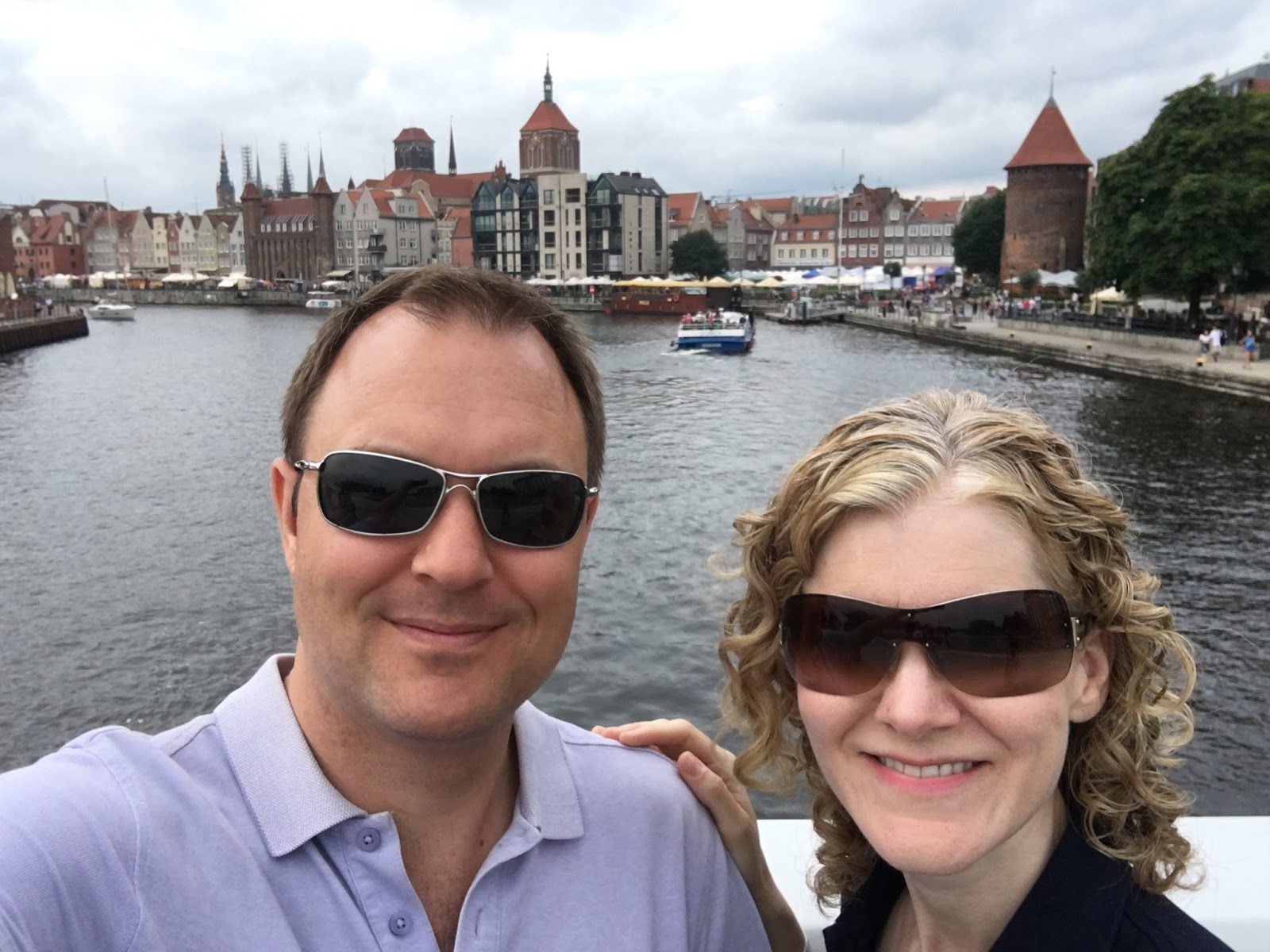
Our last stop in Poland was Gdansk, Poland’s principal seaport (we had this route planned before Prince William and Kate executed the same path earlier in the summer!).

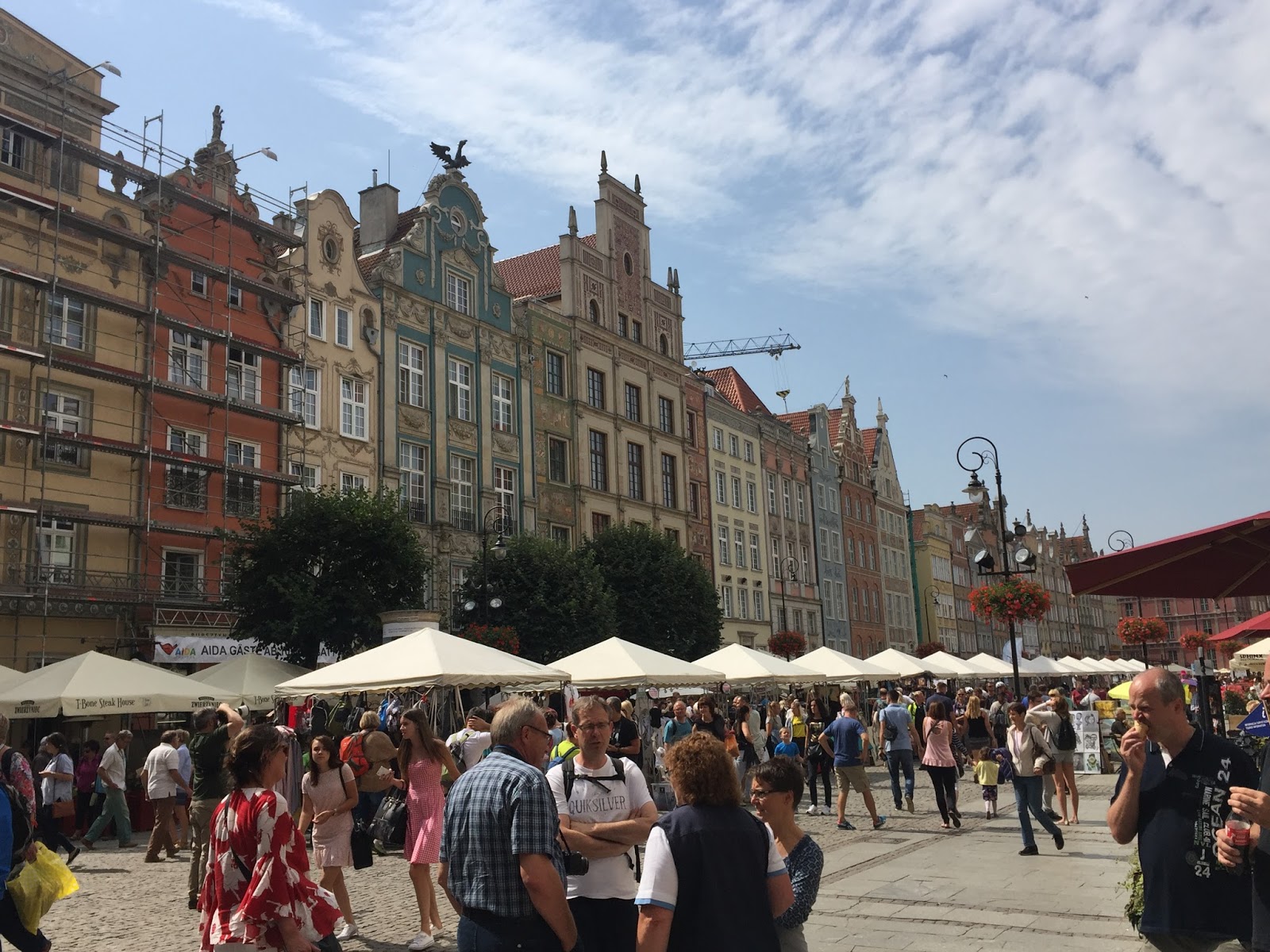
Unbeknownst to us when we originally booked (do I need to mention the missing travel mojo again!?) we arrived in Gdansk during its annual festival, St. Dominic’s Fair, which attracts over 6 million visitors annually.  No wonder our hotel seemed so expensive! 

St. Dominic’s Fair dates back to 1260, originally introduced to encourage merchants from around the world to meet and trade both commodities and culture.  Today, hundreds of merchants from around the world gather to commemorate this tradition and trade their goods.  The only requirement is that no name brands are allowed – merchants have to sell uniquely crafted merchandise.


Stalls line the waterfront and the streets in the Old Town.  It can take days to wander through and look at everything, especially when distracted by the myriad musicians and buskers that tempt you to stop and listen. 

Nonetheless, we ventured out each day to check out the different stalls and hunt for the perfect piece of Amber jewellery to give as a gift.  Gdansk is famous for its amber, recognized as the largest trader of Baltic Amber in the world.  Amber has been traded in Gdansk for over 6,000 years and was a major contributor to the success of the city.  Not surprisingly, we found success ultimately on Mariacka Street, also informally known as "Amber Street" because it has the best vendors.

In the spirit of the Festival, we spent most of our time in Gdansk wandering the streets, buying snacks from street vendors (who conveniently made food into a necklace for ultimately portability), enjoying drinks at many a patio and finding the most delicious potatoes-only restaurant!  Hard to think of anything more festive!


Sunday, 8 October 2017

Delicious days off...

On our hiking days, we ate responsible breakfasts of fruits, nuts and grains and lots of water.

On our day off, Beth partook of the real delights of the buffet breakfast – a variety of cakes washed down with a glass of bubbly.  

It was the most delightful breakfast…that totally wiped away all of the health benefits of the hiking.  

Hot hikes

In between work, we did a couple of fantastic hikes during our stay.  

Having brought with us our ski jackets, gloves and hats to be comfortable in climate that was forecast, we had to change our strategy somewhat when we were met with an unseasonable heatwave that had the climate reaching the mid-30s in the middle of the day!  Naturally, the ski jacket was shelved and substituted with our gym clothes! 

The first trail left right from our hotel and took us straight up the mountain to a beautiful arctic-looking lake. It was long and exhausting but well worth it.


For the second, we drove into town and then took a funicular before starting our ascent in hopes of reaching a cable car (that still had tickets available) to take us to the mountain’s top peak.  

Not being diligent enough at confirming the path en route, however, we ended up on a completely different trail.  It was a beautiful hike but after two hours, we began scaling rocks up the  mountain.  Starting to (likely unjustifiably) fear for our safety (Beth not Geoff), we decided to cut our losses and turn back.  
Thank goodness we couldn’t purchase the cable car tickets in advance!


And after a long and bizarre day, there was little more welcoming than soothing our achy muscles with a little relaxation (and a glass of bubbly!) in the Adults-Only area at the spa.


Not quite the Grand Budapest Hotel...

Eager to do some hiking, we investigated online and found an adorable looking hotel in the Tatra Mountains.  It reminded us of the hotel façade in the movie, The Grand Budapest Hotel, so although it was expensive, we decided to go for it and booked it and a rental car to get us to Slovakia.

The drive to Slovakia was a beautiful one – even if a bit slow at times as we dodged the Tour de Polonia bike race that happened to take place on that very day and follow our very route!

Eager to take a break en route, we found a well-rated and charming chalet-type restaurant and scarfed down some perogies to fuel up but get done in time to beat the oncoming bike race.

As we crossed over into Slovakia – almost an unnoticeable marking – we were struck by the immediate difference in road conditions and houses.  Driving through Poland, we were impressed by the well-maintained roads and well-maintained and large houses that lined the streets.  In Slovakia, the roads were cracked and uneven and the houses felt unkempt.  

As we wove our way up the mountain, stopping first to buy the road permit and then to pick up some wine at the local gas station (!), we were beginning to wonder if this was our best idea after all.  The mountains were stunning but the accommodations we passed seemed lost in a different time.  And not in a good way.

As we turned the corner to head down the final street to our hotel, we were stopped by a security guard who was turning away the masses of local tourists eager to sneak a peak.  This was not quite the serenity we expected.

We pulled up to the hotel to find an attractive exterior and were greeted at the door with a glass of sparkling wine feeling instantly hopeful that things were back on track.  But as we checked into our room and went out onto the patio to take a look at the beautiful mountain surround, we were met with a view of the parking lot - which we had paid substantially more for.

As the hotel was full, the front desk informed that they could not change our reservation but that we could get our fill of the outside using their beautiful outdoor facilities.  Upon investigation, we learned about a strict rule prohibiting outdoor development/allowances in the area (?!); we documented this as four outdoor tables and a smoking tent, all of which were full. 

Disheartened, we spent the next hour online looking for alternatives and considering whether to just head straight to Gdansk.  Luckily, getting the hotel manager involved, we were able to find a decent solution that, although imperfect, at least offered us some better views of nature.

Putting the situation behind us, we decided to head over to an International Folk Festival that was happening on the other side of the lake.  The turnout was enormous with several thousand seats sold out and the grassy picnic areas along the side buzzing with people.  

Perhaps due to the afternoon’s conversations or perhaps the several welcome drinks that they offered to us as we got everything sorted, we arrived wholly unprepared for the evening, without sweaters to wear or blankets to cover the very damp ground.  We had totally lost our mojo.

Nonetheless, for the next hour we took in the traditional folk dancing and singing that Geoff had craved to see as we planned our Polish adventure.  The performances were professional and impressive and even though the singing hurt our ears sometimes, the evening was a splendid display of local culture.

As we walked back to the hotel, we sucked in all of the outdoor air we could before heading inside for dinner and bed.


Poland's beautiful music

The Krakow Philharmonic Orchestra was created in 1945 shortly after the war ended and has evolved to become the most active orchestra in Poland. 

During the summer, the Orchestra offers a series of weekly performances in spaces around Wawel Castle. Naturally, we wanted to go and check it out. 


Listening to four oboeists play a diverse and gorgeous programme of songs enhanced by a regal backdrop of historical paintings and high ceilings was magnificent and helped us to forget that these old buildings don’t offer air conditioning even in the most intense of summer heat.  The handheld fans they offered for the performance also helped to transport us back in time for a delightful evening of music, which is starting to feel like a frequent experience for us here in Poland….


The Cherry on Top!

Beth certainly felt her Polish roots surge to the forefront when tasting Cherry Vodka, a Polish delicacy and the most delicious beverage.  Thank goodness this drink is not readily available elsewhere….

The Jewish Quarter's Re-birth

Kazimierz – also known as Krakow’s Jewish Quarter – is a 15-minute walk from Krakow’s Old Town.  For over 500 years, Kazimierz was a place of peaceful coexistence between the ethnic Polish and Jewish communities and was the centre of Jewish life until the Nazis took control of Poland.

When the Nazis took control of Krakow, newly appointed Governor General Hans Frank declared that Krakow would become the most “racially pure” city in all of Europe and expunged all but 15,000 Jews from the city.  These remaining individuals were forced from their homes into to the Jewish Ghetto located in the industrial area on the other side of the river, far enough away to keep the rest of the population “clean and safe”.   One of the notable residents was Roman Polanski who recounted his experiences there many years later. 


The Ghetto was physically very small, with room for about 3,000 individuals versus the 15,000 that lived there.  Without enough space inside the homes to house everyone, many ended up living on the streets and, much like in Warsaw, disease and illness ran rampant.

In the centre square of the Ghetto – now named Ghetto Heroes Square – are 33 iron/bronze chairs – bringing to life a haunting photograph that captured the Jews moving to the Ghetto and being forced to carry all of their possessions – including chairs – on their person.  Approximately 33,000 Jews perished in the Krakow Ghetto. 

When all of the Jews had been moved to the Ghetto, a wall was erected around it.  In a symbolically cruel gesture, the wall was designed in the shape of tombstones…and the construction began right at the start of Passover, a time when the Jewish community celebrates their liberation from slavery in Egypt.

There are some stories of the Gentile resistance in Krakow, such as Polish Roman Catholic pharmacist Tadeusz Pankiewicz, who obtained permission from the German authorities to run the "Under the Eagle Pharmacy" and treat the community living in the Ghetto.  And others, like Oskar Schindler, who although a controversial figure, is also recognized with fighting for and saving the lives of 1,200 Jews by employing Jews in his enamelware and ammunitions factories and paying off Nazi guards in order to house them close to the factory and keep them safe.  Schindler’s old factory is now a museum tracing the horrors of WWII in Krakow.

After the war ended, the Jewish Quarter fell into disrepair under Communist rule and became one of the city’s dodgiest districts.

In the 1990s, however, Steven Spielberg filmed Schindler’s List in the Quarter, bringing new attention and life to the area.  Tourists came from all around the world to reflect and learn more, helping it to re-emerge as a bustling, bohemian neighbourhood full of historical sites and atmosphere.
The Jewish Quarter was easily our favourite area of Krakow, with quaint houses and uneven streets, innovative (and vegetarian!) restaurants and an overwhelming feeling of warmth and authenticity.  
And we are not alone.  Many believe that Kazimierz is the European city that conveys the most genuine sense of what pre-war Jewish and Polish life was like, with synagogues and Jewish cemeteries still intact and houses similar to what would have existed before the Nazis invaded. 

While in the Jewish Quarter, we did our best to embrace Jewish culture, eating at many Jewish-inspired restaurants and listening to a live Klezmer performance, which was haunting yet warm and much more enjoyable than we had anticipated.  But in the back of our mind, we knew this district wasn’t completely authentic – of the 60,000-80,000 Jews living in the city before the War, there are now only 700 that remain, far smaller than the Quarter can accommodate and making the tragedy feel even more real.