Showing posts with label Granada. Show all posts

Wednesday, 29 July 2015

The Many Sides of Granada...

All streets look to Alhambra (summer home)
For our final day in Granada (and Spain!), we were eager to see the town that had developed around the Alhambra and headed out to explore Albayzin (the Muslim Quarter) and Sacromonte (the Gypsy Quarters). 

Granada’s old Muslim Quarter sits on the hill facing the Alhambra.   The Quarter developed in the 1100s but survived long after the Christians conquered the territory.  All of the streets and plazas in the community were designed to have a view of the Alhambra and Summer Palace, which can be seen at almost every turn.  This made for a very beautiful walk and gave a completely different view of the magnificent citadel.

In order to block out the sun and intense summer heat, the streets are very narrow.  As a safety measure, the streets appear somewhat sporadic, with curves and dead-ends and no real main street.  These, paired with the hilly surround provided a secure place for people to live. 

The cobblestone streets are lined with gorgeous Carmens (large homes with walled vineyards, some which actually grow grapes and others that just offer nice gardens).  The word, Carmen, was created from the Arabic word, “karm” for “garden”.  The Christian conquerors, however, found this word very difficult to say and, as such, added the “en” on the end to make it more manageable. 

Perhaps the most beautiful view of the Alhambra is at Mirador St. Nicolas, which boasts a beautiful church and a large square with unblocked views of Alhambra and surrounding Sierra Nevada.    It also hosts the  Mezquita Mayor de Granada, which is the first new mosque built in the region in the last 500 years. 

After the conquest, many churches were built in Albayzin.  Some were built on empty land and other were built over existing mosques.  Interestingly, one way to determine whether it was new or rebuilt is to look for a well nearby.  As Muslims routinely wash before prayer, any church built next to a well is believed to have been built over existing mosques.

As for the wells in Albayzin, UNESCO’s official count is "29" but the locals know the number is not accurate.  It is a local “secret” that many people have wells right in their Carmens and homes but will not tell the authorities for concern about the associated restrictions as well as having to make their homes more available to the public.

The local neighbourhood is no longer primarily Muslim but rather comprised of a variety of local cultures.  But the community itself is very close knit.  The majority of people who live there spend all of their time there, eating at the local restaurants and going to the local shops.  To go to the downtown area is considered having to go to “Granada, a completely different city”!

Abutting the Albayzin is Sacromonte, Granada’s thriving Roma community.  Even though the districts sit right next to each other, however, their vibe, culture and even their climates feel completely different!

The gypsies, originally from Northern India, arrived in the mid-1400s and lived in relative harmony with both the Muslims and Christians for hundreds of years.  After the Reconquista, the gypsies apparently went to Isabella and Ferdinand and warned them that they needed gyspy support and then asked for a piece of land.  As a result, the royal couple gave them Sacromonte.

Unlike its neighbours, this community did not build large homes and gardens.  Instead, because of the very hilly landscape, the residents actually carved cave homes right into the mountain.  This allowed them protection from both strangers and also from the heat!

Today, many immigrants and “hippies” come and settle in the area, carving our space for themselves wherever they can find it.

The area feels quite desert-like, with cactuses and sand covering much of the space.  This area too has beautiful views of the Alhambra and the building of the caves up the hill give everyone a scenic view.

Dancing in the City...

Because the gates of the Alhambra are locked at night, most of the guests at the Parador Hotel choose to do "half-board" and eat dinner on-site.

We learned the hard-way that booking dinner at 9pm (considered early for Spain, where the summer sun doesn’t set until after 11pm!) is not the smartest as the entire hotel shows up for dinner at that time.

As such, three and a half hours later we were just about finished our meal.

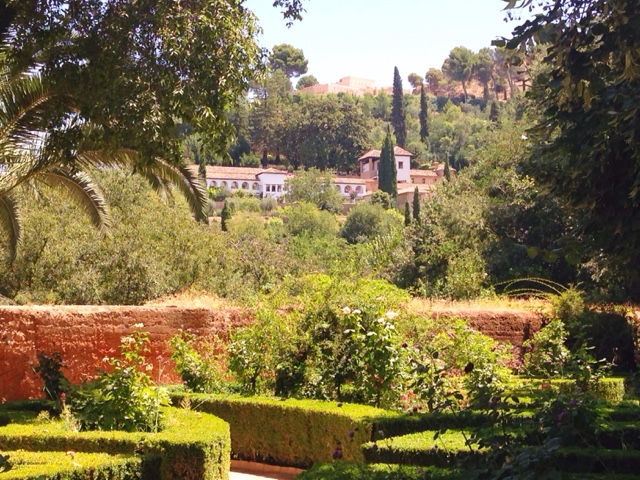
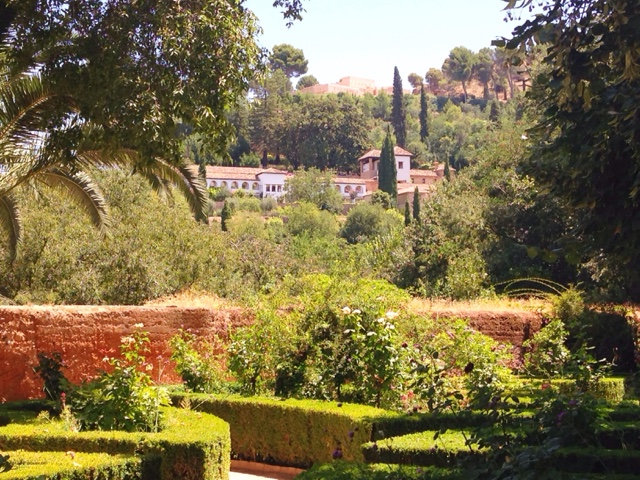
Nonetheless, watching the sun slowly and finally set over the Palacio de Generalife (aka. The Summer Palace)  was exquisite and delightful.

The gorgeous Palacio de Generalife
In addition, the slow dinner pace also gave us the opportunity to hear some of the Poeta En Nueva York performance that was taking place in the grounds of the Summer Palace.  The music sounded intense and spirited and piqued our interest about the show.

As such, we booked tickets for the next night.

Thinking that we had outsmarted the system by booking online rather than waiting for an hour at the ticket office, we were alarmed to find out only a couple of hours before the show that we would need to go to an El Corte Ingles (a large department store) to pick-up the printed tickets.  As such, our early and leisurely dinner was turned onto its side and we hopped into a cab to hurry into town.

Hammering down our meals and skipping dessert, we faced another set back as the gate we expected to go through to get to the venue was already locked for the night.  This left us running to the main entrance gate, down the hill and then all the way back up again to make it – panting and hot – to the performance venue.

Unbelievably, we made it to the concert only a few minutes after the start-time but before the performance actually started. As we watched ten minutes go by with the performance still "to begin shortly", we thought longingly about the tempting desserts we had left behind.


Although we didn’t really understand the show – not just the talking parts but also how the different pieces of the show actually fit together – the dancing was innovative and skillful and the routines captivating.  But it was the open-air venue and historical backdrop that made the evening truly memorable.  And as we walked back – slowly – to our hotel after the show, we both agreed that the chaos and running around was totally worth it!

The Parador Hotel


Granada's Walled City...

Our train trip to Granada was relatively smooth, even though half of it was on a bus due to some track work.  Our cunning and likely overly-thought-out plan to get a cab, however, was perfectly executed and we were on the road to the Alhambra within minutes.

We arrived at the historical Parador Hotel in the walled city and were encouraged to embrace a “once in a lifetime “ upgrade due to a last minute cancellation.  Although we managed to negotiate the upgrade fee to a much lower and more acceptable price, we checked in to find that the room was not quite what we expected.  Note to self:  Always see the room before agreeing to an upgrade!

The historic Parador Hotel
Nonetheless, the hotel itself was an incredible experience.  The Parador Hotels in Spain are converted historical sites that are entirely controlled and maintained by the government.  This hotel was part of a palace and mosque that was built in the 1300s and was later converted into a Fransciscan Convent. Part of the building was the former chapel where Queen Isabella and King Ferdinand were buried until their remains were moved to the Royal Chapel.   

The Alhambra itself is the most famous Moorish citadel and palace in Spain.  It was primarily built in the 1100s and turned into a palace in the 1300s under Yusuf 1.  Alhambra is defined as the Red Palace - some believe this is because of the red bricks used while others think it was because the Sultan had a very red beard!


Knapsacks MUST be worn in the front!
Although many Moorish buildings were destroyed when the Christians conquered Muslim territory, it is believed that the conquerors were so in awe of these buildings that they left them untouched.  As such, the area offers one of the best-preserved architectural examples of Moorish design.

The Palace in the Alhambra has three different sections – the public area (for judicial and administrative duties), the principal residence of the King, and the Palace of the Lions, which was the private area of the Palace.  Each section had a slightly different feel to it, with the first two areas having a much stronger Muslim design influence. Each, however, was adorned with colourful decorative tiles and motifs and many beautiful arches.  In the middle of the Complex was a long pool of water, once again reinforcing the Muslim tradition of cleanliness and purity. 

Over the years, the Alhambra underwent some expansion. Charles V, for example, added several rooms as well as the Charles V Palace.  This dramatic “Circle in a Square” design took years to build and sits unfinished today.  It is considered one of the most important Renaissance style buildings in Spain but oddly seemed to actually attract the sunshine rather than protect from it and, although very attractive, didn’t seem remarkably functional.  Perhaps this is why it was never finished...


Perhaps the most lovely palace is the Summer Palace (“Generalife”), which was only a 10-minute walk away from the Alhambra.  With exquisite gardens, this Palace was "less grand" but was remarkably cool and breezy and offered stunning views of the Alhambra and below city.

Although it seems odd that they would build the summer residence so close to the official residence, we were told on several occasions that there was such in-fighting and drama about who controlled the Alhambra that rulers did not want to ever stray too far away!


We were also told that it was this in-fighting that caused their eventual demise.  Apparently, Isabella and Ferdinand had troops stationed nearby for many months, just waiting for the time when the in-fighting started to cause such distraction and hardship in the city that it was ripe for takeover.


The gates of the Alhambra are locked at night, clearing out the city and allowing the guests of the Parador to enjoy the city with very few tourists.  Getting up early to quietly watch the sunrise over this magical historical city may not have justified the hotel upgrade fee but definitely made the decision to stay at the hotel feel like a brilliant one.