Sunday, 19 April 2015

Sugamo's Shopping Street

As Japan has one of the oldest average age populations in the world, it is not surprising that they have a shopping neighbourhood that caters specifically to the older generation.  Sugamo Shopping Street, its formal name, is often lovingly referred to as the “Harajuku of the old ladies”. 

Naturally, Beth couldn’t wait to go and check it out.

The street itself is flat and fully accessible, with gentle slopes to separate the street from the sidewalk and the sidewalk from the shops.  This also helps to prevent flooding from any rain.  The main square has lots of benches with a wide open space in the center for people to gather.

The crosswalks are brightly coloured with perforated colour blocks for those who may have vision challenges.  The crosswalk signage is bigger and louder than those in the rest of the city.

One has to wonder if this is what streets of the future look like – easy to walk and accessible to all.  It certainly gets you in a cheerful shopping mood…

Broken Robots...


We are reluctant to even write a post about our evening at the Robot Restaurant, considering how bad it was.  

Although it came highly rated on travel sites and was touted by numerous celebrity visitors (including Katy Perry – who actually visited twice!), the Robot Restaurant was a total disaster. 

They called it a “Robot Show” but there were no real robots.  Just terribly cheesy acts with cheap looking props and actors you sensed would rather have been anywhere else.  

Sometimes reviews aren’t all they are wound up to be….


Thursday, 16 April 2015

UniQlo Serves For the Win

Although Japan is enjoying a fairly warm spring, our current wardrobe has certainly not been warm enough.  

As such, we made a trip (or two) to UniQlo to support the local favourite shop and also one of our favourite tennis players, Novak Djokovic.  

With limited choices, we bought some remarkably similar sweaters and rain jackets which is only going to enhance our already serious problem of matching outfits....

Booming and Brilliant Tokyo

The world’s largest city is an intriguing and complex metropolis.  Its architecture has been heavily influenced by two major events – the 1923 Great Kanto earthquake and the extensive bombings during WWII - both which ravaged the majority of the city.  As such, the urban landscape is relatively new and has a very practical, albeit slightly less grand, feel.  
What the city lacks in architectural “wow factor”, however, it makes up for in efficiency and cleanliness.  In a city of 30 million people, we have yet to see a piece of garbage littering the street or graffiti on the side of even one building.  The streets actually look like they are washed everyday.
This pride of ownership and respect for community can be felt far beyond the architecture:  For example:
  • Lines to get on and off the subway are orderly with the first arriver getting the front place in line and the others forming neatly behind as they arrive.  
  • Payments at stores or restaurants are made by placing the cash or credit card neatly in a dish for collection and then returned accordingly after the purchase is completed.  
  • Hordes of people show up for cherry blossom celebrations and sit on massive tarps under the blooming trees and every single person takes their shoes off before stepping onto the sheet to ensure things are kept neat and clean.
  • People wear masks not only to minimize allergies from the pollen but also to prevent the spread of illness when they are feeling unwell.
Being surrounded by people who are so aware and conscientious of those around them inspired the better in us too.  We naturally found ourselves refraining from talking on the subway and checking our shoes before getting in a taxi to make sure we didn’t accidentally bring in any dirt.  The sense of community is intense even in such a big place.


There are so many fascinating areas in Tokyo...  
  • Shibuya - A prime shopping area where thousands of people hurry across a 4-way crosswalk - The Shibuya Crossing - on weekends.  
  • Harajuku - The home to Tokyo’s fashion district and a surprisingly popular place to buy popcorn.  Lines for Garrett’s popcorn shop start half an hour before opening and curl around the block by the time the store opens its doors.  
  • The Imperial Palace - This district offers beautiful places to walk, with a serene river lined by stunning cherry blossom trees. 
  • Akasaka - One of Tokyo's central business districts and full of corporate headquarters and gorgeous hotel
  • Ginza - The prime shopping and entertainment district which houses some of the most expensive real estate in the city.
Tokyo has so many interesting areas and hidden gems, you could spend a month here sightseeing and barely scratch the surface of all it has to offer....

Reflection

The Gates to the Meiji Shrine
Although Japan has two dominant religions – Shinto and Buddhism – locals seem quite utilitarian when it comes to practicing, often choosing one or the other depending on which best fits the particular occasion.  For example,  many associate Shinto rituals with birth and wishes for success and Buddhist practices with  ceremonies around death and remembrance. 
Tying up the bad fortunes
Japanese appear to believe very strongly in the power of a wish and good luck and many go to pray at the Shinto Shrines when they are eager for something to go their way.  There are numerous good luck charms that people carry with them to promote things like safety, good fortune and  health.
A place to write wishes
There are also some beautiful associated rituals.  Making wishes is often a strategic process involving the tossing of a coin, clapping or bowing and clasping one’s hands together.  There are also plaques for people to write down and then hang their wishes.  
In addition, people often collect their fortunes at the shrines.  Those who receive good fortunes carry those notes with them but those who receive bad fortunes tie them to a nearby fence to ensure the bad fortunes are left behind when they leave. 

MEIJI SHRINE:

Sake offerings
Undergoing the cleaning ritual before entering
Meiji Shrine in Shibuya is widely considered Tokyo’s greatest shrine and was built in 1920 to commemorate Emperor Meiji and Empress Shoken.  The Emperor is credited with bringing Japan into the modern era during his reign in the 1800s.  The Shrine is visited regularly by locals, particularly around New Years where over a million people coming to make wishes for a good year ahead.  Extensive offerings of sake and wine line the walkway to the actual shrine.    While visiting the Shrine, we were lucky to stumble on a Shinto wedding taking place – with the bride wearing a hathorn (a large hat to "cover her horns"!) and the bride and groom and their immediate families marching through the square.

SENSO-JI:
Senso-ji is an ancient Buddhist temple in Asakusa.  It is Tokyo’s oldest temple but has embraced modern elements to stay relevant and appeal to the youth.   As an example, it hosts Tokyo’s largest and most popular festival, Sanja Matsuri.  At the entrance to the grounds is a large “thunder gate”, featuring an enormous paper lantern that is said to weigh 700kgs.  The gates open onto a thriving shopping arcade where local treats and knick knacks abound.

ZOJOJI TEMPLE:
The Zojoji Temple in Minato is a shrine that is primarily and visited by locals, rather than travellers.   It is located in the business district and was abuzz during lunch hour as people came to enjoy the outdoor spaces and take time for reflection.  The Temple leaders here have also worked hard to ensure its continued relevance for today’s generation, often projecting installations onto the attractive buildings.

One of the touching features of this Temple is the Unborn Children Garden which hosts rows of stone child statues representing children who were lost before their time.  Parents can choose a statue in the garden and decorate it with small clothing and toys.  Most also have pinwheels spinning the in the wind to embrace the free nature of the children and also draw in more adults and children to reflect on the deeper message.


When in Japan...

Eager to embrace the Japanese culture, we opted to stay in a Tokyo Ryokan rather than a hotel.  These traditional inns originated during the Edo period (1600-1870) and generally feature tatami-matted rooms, communal baths and large common areas.  Many ryokans will serve breakfast and dinner, and we enjoyed the breakfast (particulary the incredible toast) to the fullest.  
During the day, the room is set-up as a living room (with a table, chairs and items for making tea).  In the evening, the room is transformed into a bedroom as the light furniture is moved to the side and some futon mattresses are laid on the floor as a bed.  
The Edo Sakura Ryokan where we stayed was a fairly modern Ryokan, with very clean and remarkably functional rooms and private bathrooms.  There were also public baths available, which we tried, but it was by no means the only choice for getting clean in the morning.    The futons were thin but reasonably comfortable and we slept well during our stay.
Ryokans offer some of the best of Japanese culture – brilliant and functional design, incredible attention to and pride in the small details, hosts that are kind and eager to make you feel comfortable - and offered an unexpected highlight of our trip.
  

A Stunning Start to Spring...


The Japanese Cherry Blossoms are said to be one of the most beautiful starts to spring so we did our best to organize a trip to Japan to see them in bloom.

We were clearly not alone in our thinking!  Hotel rooms were in scarce supply and we actually ended up having to schedule a trip out of Tokyo for the weekend in order to actually have somewhere to stay.


We were incredibly fortunate though with our timing, arriving on the first when the sakuras (aka. Cherry Blossoms) were in full bloom.  The sakura bloom is very short (often only about a week) and as the timing of the bloom varies every year depending on the weather, planning can be quite tricky.  
  
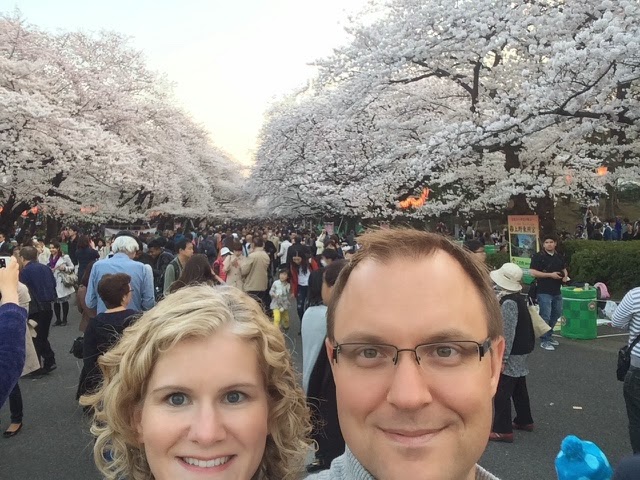
When the cherry blossoms finally emerge, the locals embrace them to the fullest.  The parks are crammed with people coming to take a look and enjoy this wonderful start to spring. 

The incredible (and orderly!) crowds of people
The locals also embrace a custom called “Hanami” where they set up blue tarps underneath the cherry blossoms and hang out there throughout the day and well into the night.  Offices often send out interns and new employees to secure a good picnic spot and guard it until the other employees can make it after work.

We crammed in a lot of cherry blossom viewing over a few days (visiting Ueon Park (several times!), Yoyogi Park and the Imperial Palace grounds where cherry blossoms abound).  We also took far too many photos.  So although it looks like we have posted tons of photos here, the number is actually a dramatic edit from the 200 photos we actually took!


Even Starbucks got in on the Cherry Blossom action (note the hanging flowers in the store too)!